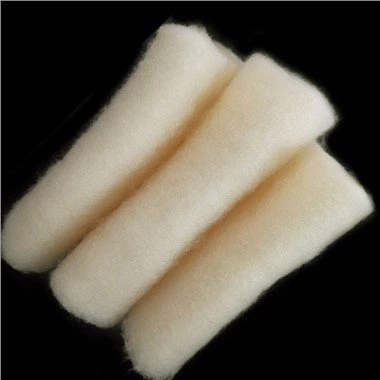
The problem of uneven thickness of non-woven fabrics
Jul 15, 2021
The reasons for the uneven thickness of non-woven fabrics under the same processing conditions may include the following points:
(1) Uneven blending of low-melting fiber and conventional fiber: Different fibers have different cohesive forces. Generally speaking, low-melting fiber has greater cohesive force than conventional fibers and is less easy to disperse. For example, Japan 4080, South Korea 4080, South Asia 4080 or Far East 4080 all have different cohesive forces. If the low-melting fiber is unevenly dispersed, the low-melting fiber content is less, because it cannot form a sufficient network structure, and the non-woven fabric is thinner. , Relatively thicker is formed where the content of low-melting fiber is more.
(2) Incomplete melting of low-melting fiber: Incomplete melting of low-melting fiber is mainly due to insufficient temperature. For non-woven fabrics with low basis weight, it is usually not easy to cause insufficient temperature, but for high basis weight, high Special attention should be paid to whether the thickness of the product is sufficient. The non-woven fabric at the edge has enough heat, the non-woven fabric is usually thicker, the non-woven fabric at the middle part, because the heat is not easy to form a thinner non-woven fabric,
(3) High shrinkage rate of fiber: whether it is conventional fiber or low-melting fiber, if the hot air shrinkage rate of the fiber is too high, it is easy to cause uneven thickness due to shrinkage during the production of non-woven fabrics.
The problem of static electricity during the production of non-woven fabrics is mainly caused by the low moisture content in the air when the fiber and card clothing are in contact. It can be divided into the following points:
(1) The weather is too dry and the humidity is not enough.
(2) When there is no oil on the fiber, there is no antistatic agent on the fiber. Because the moisture regain rate of polyester cotton is 0.3%, the lack of antistatic agent results in static electricity during production.
(3) The fiber oil content is low, and the relatively low content of electrostatic agent will also generate static electricity.
(4) SILICONE polyester cotton because of the special molecular structure of the oil agent, there is almost no moisture on the oil agent, and it is relatively easy to generate static electricity during production. Usually, the smoothness of the hand feel and the static electricity are in a positive ratio. The smoother the SILICONE cotton, the more static Big.
(5) In addition to humidification in the production workshop, the method of preventing static electricity can effectively eliminate oil-free cotton during the feeding stage is also an important task.
Under the same processing conditions, the causes of uneven softness and hardness of non-woven fabrics are generally similar to the causes of uneven thickness. The main reasons may include the following points:
(1) The blending of low-melting fiber and conventional fiber is not uniform. The part with higher low melting point is harder, and the part with lower melting point is softer.
(2) Incomplete melting of low-melting fiber causes softer non-woven fabric
(3) The high shrinkage rate of the fiber will also cause the problem of uneven softness and hardness of the non-woven fabric.